The NAR Settlement: What Actually Changed, and What Didn't
Commissions were not eliminated. They were not capped. Two specific things changed on August 17, 2024 — and almost every viral version of this story gets both of them wrong.
There is more confidently wrong information about this than about any other topic in real estate right now — including from agents.
You have probably heard some version of “commissions were eliminated,” or “sellers don’t pay the buyer’s agent anymore,” or “the 6% is dead.” None of those is accurate.
Here is what actually happened, in plain language, and what it means if you are buying or selling a house in Minnesota.
The NAR settlement produced two practice changes, effective August 17, 2024. Offers of compensation can no longer be published on the MLS, and a buyer must sign a written agreement stating their agent’s compensation before touring a home. That is the entire scope. Commission rates were not set, capped or eliminated, sellers can still pay the buyer’s agent, and no new law was created. Compensation became visible and negotiated instead of embedded and assumed.
What was the lawsuit actually about?
A group of home sellers sued the National Association of REALTORS® and several large brokerages. The core allegation concerned how buyer-agent compensation worked: listing agreements typically committed the seller to pay both sides, and the offer of compensation to the buyer’s agent was published on the MLS where buyer agents could see it before showing the home.
The claim was that this structure kept commission rates artificially uniform.
NAR settled. As part of the settlement, NAR agreed to two specific practice changes, which took effect August 17, 2024. That is the entire scope of what changed. Two practice changes.
Compensation offers came off the MLS
The settlement prohibits publishing offers of compensation on an MLS.
This is the change people misread as “sellers stopped paying buyer’s agents.” That is not what it says. Sellers can still offer compensation to a buyer’s agent. What changed is that the offer can no longer be advertised on the MLS. Listing brokers now communicate it through channels other than the MLS.
So compensation did not disappear. It moved — out of a field on a listing sheet and onto the negotiating table, where it gets worked out deal by deal.
Written buyer agreements before touring homes
MLS participants working with a buyer must now have a written agreement in place before that buyer tours a home.
Those agreements have to state compensation specifically. Per NAR, the amount must be “objectively ascertainable” and “not open-ended.” No blank line, no “whatever the seller offers.”
This is the change that affects buyers most directly, and it is the one buyers should understand carefully.
What did not change?
This is the part worth reading twice, because almost every viral version of this story gets it wrong.
- Commission rates were not set, capped, or eliminated. NAR’s position is that compensation “is not set by law and is fully negotiable.” That was true before the settlement and it is true after. The settlement changed how compensation is communicated and documented — not what anyone is allowed to charge.
- Sellers can still pay the buyer’s agent. Many still do. It is negotiated on the offer rather than advertised on the MLS.
- Agents were not eliminated. Buyer representation still exists. It is now documented up front instead of assumed.
- There is no new law. This is a settlement of a civil lawsuit producing changes to MLS rules and REALTOR® practice. It is not legislation and it did not create a statute.
What does this mean if you are selling in Minnesota?
You decide whether to offer buyer-agent compensation, and how much. It is a negotiating decision now, not a default. You are not required to offer anything.
If a buyer’s agent is owed 2.5% under their buyer agreement and you offer zero, that buyer has to cover the gap out of pocket — on top of their down payment and closing costs. Some buyers can. Many cannot, and they will simply focus on other houses.
That is the calculation, and it is genuinely a calculation rather than an obvious answer in either direction.
It gets negotiated at offer time. Expect compensation to show up as a term in the purchase agreement alongside price, closing date, and contingencies.
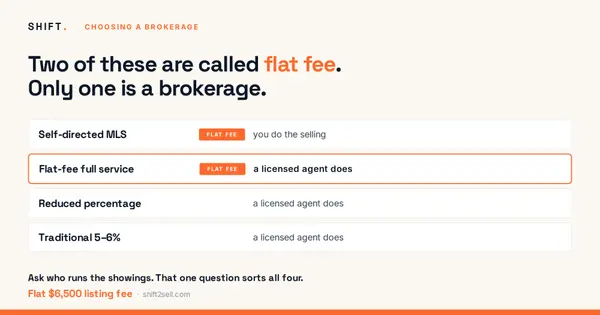
This is where a flat listing fee gets easier to reason about. When your listing fee is a flat $6,500 rather than a percentage that bundles both sides together, the two questions separate cleanly: what you pay to have your home sold, and what — if anything — you offer the buyer’s side. They were always two different things. Now the paperwork reflects that.
For the practical numbers on what sellers in Minnesota are actually offering, see who pays the buyer’s agent in Minnesota.
What does this mean if you are buying in Minnesota?
- Read the buyer agreement before you sign it. You will be asked to sign one before touring. It states what your agent is owed, and it is a contract. This is the single most important document change from the settlement and the one buyers most often sign without reading.
- Understand the gap scenario. If your agreement says your agent gets 2.5% and the seller offers 2%, you owe the difference. On a $400,000 home that is $2,000 out of pocket at closing — money that is generally not financeable the way a down payment is.
- It is negotiable. The rate in your buyer agreement is between you and your agent. So is its length and its scope. You can negotiate all of it, and you can limit the agreement to a shorter term or a specific property while you decide.
- Ask what happens when the seller offers less. Get the answer before you sign, not after you find a house you love.
The honest summary
The settlement made compensation visible and negotiated instead of embedded and assumed.
That is it. Nothing was outlawed. Nothing was capped. The number is no longer advertised on the MLS, and buyers now sign an agreement stating what their representation costs before they start touring.
Whether that produces meaningfully lower costs for consumers over time is still an open question, and anyone who tells you they know the answer is guessing. What is true today is that the conversation now happens out loud, at a point where you can actually do something about it.
This is a plain-language explanation of publicly documented practice changes, not legal advice, and we are not attorneys. The settlement and its implementation involve litigation still working through courts and rules that vary by MLS. For questions about your specific agreement, talk to a Minnesota real estate attorney.
Selling in Minnesota?
SHIFT Real Estate lists homes for a flat $6,500 fee instead of a percentage commission. Because the listing fee is flat, what you pay to sell and what you choose to offer a buyer’s agent stay two separate decisions — which is exactly the structure the settlement pushed the whole industry toward.
Run your net proceeds Who pays the buyer’s agentNAR Settlement FAQs, National Association of REALTORS®
Published by SHIFT Real Estate Team · 261 7th St W, Saint Paul, MN 55102 · (651) 224-4663 · Flat $6,500 listing fee across the Minneapolis–St. Paul metro and greater Minnesota.
Categories
Recent Posts