How to Choose a Flat-Fee Brokerage in Minnesota
There are four genuinely different ways to sell a house in Minnesota, and the phrase “flat fee” gets used for at least two of them. Here is how to tell which one you are actually being offered — and the six questions that get you a real answer.
“Flat fee” is not a product. It is a phrase that two completely different businesses both use about themselves, and the difference between them is the entire decision.
One of them puts your house into the MLS for a few hundred dollars and then goes away. The other is a licensed brokerage that does everything a 5–6% agent does and bills a fixed number instead of a percentage. Both advertise a flat fee. Both are telling the truth. A seller comparing them on price is comparing a data-entry service to a real estate agent, and the gap between those two numbers is not information — it is just the gap between two different jobs.
This is not a small problem. It is the reason sellers sign up for something, discover three weeks later that nobody is going to run their open house, and conclude that flat fee “doesn’t work.” What did not work was buying one thing and expecting another.
So the useful question is not which flat fee is cheapest. It is which of these four things am I looking at, and what does it leave on my plate.
Minnesota sellers have four options: self-directed MLS, flat-fee full service, reduced percentage, and traditional. In three of the four, a licensed agent does the selling and the only difference is how the bill is calculated. What actually separates one brokerage from another is never the advertised price — it is when you pay, what the total is in writing, who runs the showings, who negotiates the offer, how the agreement ends, and how many homes they have genuinely closed.
What are the four ways to sell a house in Minnesota?
Self-directed MLS. You pay a small fee, usually upfront, and a service enters your listing into the MLS. After that, it is yours. You set the price with no access to the full comparable data an agent sees. You take the photographs. You answer the inquiries, including the ones from people who are not qualified and the ones from agents trying to convert you into a traditional listing. You schedule and attend every showing. When an offer arrives you read the purchase agreement yourself, decide what the inspection contingency really obligates you to, and negotiate the repair request on your own. This is a legitimate option. It works for people who have sold several houses, or who already have a buyer standing in the kitchen.
Flat-fee full service. One fixed fee, paid at closing, and a licensed agent does all of the above. Everything a traditional agent does, priced as a number rather than a percentage.
Reduced percentage. A licensed agent does the selling and charges a smaller slice than the standard — still a percentage, still climbing with the sale price, just a shallower climb.
Traditional. A licensed agent does the selling and charges the full 5–6%.
The four models, side by side
Read those four again and notice what the last three have in common. A licensed agent does the selling. The work is the same work — same MLS, same disclosures, same contract, same inspection negotiation. A house that sells for $700,000 does not require more showings, more phone calls, or more paperwork than one that sells for $400,000. What changes between models two, three and four is not the job. It is the arithmetic on the invoice.
Model one is the outlier, and it is the one that gets mistaken for model two, because both of them reached for the same two words. We wrote that comparison up on its own: flat-fee MLS vs full-service flat fee. If your comparison is against a standard commission instead, the numbers are here.
The change from 2024 that belongs in this math
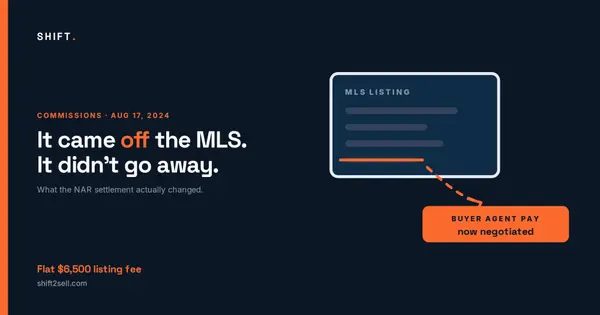
Every one of these four models got harder to compare after the NAR settlement changed how buyer-agent compensation works. Offers of compensation came off the MLS. What a buyer’s agent gets paid is now negotiated in the transaction rather than advertised alongside your listing.
That matters here for a specific reason: the fee a brokerage quotes you is the listing side only. Whatever you agree to contribute toward the buyer’s agent is a separate line, and it is a line that exists in all four models, including the one where you do everything yourself.
So when you compare a $6,500 flat fee to a 5–6% commission, make sure you know which side of the transaction each number covers. Some quotes are listing-side only. Some bundle an assumed buyer-side contribution. They are not the same quote, and the difference is thousands of dollars. We broke down how this works in practice in who pays the buyer’s agent in Minnesota.
Why the cheapest number is almost never the total
A self-directed MLS listing advertises a price that covers one thing: getting the listing into the MLS. Almost everything a seller actually needs after that is priced separately.
Professional photography. A lockbox. Changing your price or your description after the listing goes live. A yard sign. Comparable sales data. Contract forms and the disclosure package. Someone to answer the phone. Each of these is available, and each has its own line item, and none of them are in the advertised number.
None of that is dishonest — it is an à la carte business and it is sold as one. But it means the number on the homepage is a starting price, not a total, and the only way to compare it to a full-service fee is to add up everything you would actually buy and compare that.
The same discipline applies in the other direction. A full-service quote should be checked for administrative and transaction fees before you treat it as final. Which brings us to the questions.
What should you ask a brokerage before signing?
Price is the easiest thing on the list to compare and the least informative. These six are the ones that tell you what you are actually buying. Ask them in this order, and get the answers in writing rather than on a phone call you will not remember precisely in six weeks.
- When do I pay, and what happens if it doesn’t sell? Upfront or at closing is the biggest structural difference between these models, and it is a difference in who carries the risk. A fee paid at closing means the brokerage is paid only if the thing works. A fee paid upfront is spent either way — if your house sits for five months and you withdraw it, that money is gone. Ask both halves of this question. The second half is where the real answer lives.
- What is the total, including every administrative or transaction fee? In writing, before you sign. Plenty of brokerages advertise one number and add a separate administration fee at closing. That is not automatically a problem — most brokerages of every model have one. But you should learn about it now, not while you are reading a settlement statement with four people waiting on you.
- Who handles the showings, and who negotiates the offer? This is the question, and it is the one people forget to ask. If the answer is any version of “you do,” you are looking at model one no matter what the fee is called. Pay particular attention to the second half. Negotiating the offer — and then the inspection response, which is the second negotiation nobody warns you about — is the step with the most money attached to it.
- Is professional photography included, or do I supply the photos? Photographs decide whether a buyer walks through your house or scrolls past it, and that decision happens before anyone has read a word of your description. If you are supplying them, a real cost and a real skill just moved onto your plate. Ask about drone too, where the property warrants it.
- How long is the agreement, and how do I get out of it? Six months is standard in Minnesota. The length matters less than the exit — see the next section, because this is the part that costs people money.
- How many homes have you actually closed, and where are the reviews? Closed transactions, not listings taken. Those are different numbers and only one of them means the brokerage got someone to the finish line. Then read the reviews at the source rather than the three quoted on the website.
The listing agreement is the part nobody reads
You will sign a listing agreement with any of models two, three or four. It is a contract, it runs for months, and most sellers skim it because the conversation that preceded it was friendly.
Three clauses are worth finding before you sign.
The term. How long it runs. Six months is the Minnesota norm. Longer is not automatically bad, but it should be a choice you made rather than a default you did not notice.
The cancellation terms. Can you end it early, does it cost anything, and does it require cause or just notice. A brokerage confident in its service will generally make this easy. Hesitation here tells you something.
The protection period. This is the one that surprises people. Most listing agreements provide that if a buyer the brokerage introduced during the listing comes back and buys the house shortly after the agreement ends, the fee is still owed. That is a reasonable clause — it exists so a seller cannot wait out the agreement and cut the agent out of work they did. But you should know it is there, how long it runs, and whether it requires the brokerage to have given you a written list of those buyers.
Ask for a copy of the agreement before the appointment where you are expected to sign it. Any brokerage that will not send it in advance has answered a question you did not have to ask.
Are flat-fee brokerages worse than traditional ones?
There is no structural reason a genuine full-service flat fee produces a worse outcome. The MLS is the same MLS. The syndication out to Zillow, Realtor.com and Redfin is the same syndication. A licensed agent representing you owes you the same duties regardless of how their invoice is calculated. Nothing about the pricing model reaches the exposure your house gets or the contract you end up signing.
The risk is not the pricing model. The risk is assuming a service is full-service because it used the words. That is what question three is for, and it is why this article spends more space on questions than on prices.
How to check a brokerage’s record yourself
Question six is the one people ask and then do not verify, because verifying feels awkward. It is not.
Ask for closed transactions over a defined period — the last twelve months, or the last three years — rather than a lifetime total, which can be one good decade a long time ago. Ask how many were listings rather than buyer-side, because selling your house is the listing side. Then read reviews on Google and Zillow directly instead of the curated pull quotes, and notice whether the negative ones exist at all. A brokerage with fifty reviews and no critical ones is a brokerage that is collecting reviews selectively.
None of these questions are rude. Anyone who has done the work will be glad to be asked, because the questions separate them from whoever they are competing against.
Where SHIFT sits, plainly
We are model two, and since the entire argument of this article is that the label is not enough, it would be poor form to hide behind it here.
We are a full-service Minnesota brokerage with licensed agents. Comparative market analysis, professional photography with drone where the property warrants it, the full MLS listing and syndication, marketing and open houses, every showing, the offer negotiation, the inspection response, and transaction management through closing. The fee is a flat $6,500 at any sale price, due at closing, and only if your home sells.
We are not an MLS-entry service. We are not partial service. We are not percentage-based, and we do not take anything upfront.
$6,500, plus a $695 brokerage administration fee. Both due at closing, both due only if your home sells.
That is the whole number. We would rather you read it in an article than discover it on a settlement statement, because a seller who finds a fee at the table has learned something about us that no marketing page can undo.
282 homes sold. $4.3M+ kept by clients instead of paid out in commission. 4.9 on Google — the reviews are here, including whatever is in them, if you want to run question six on us.
How much should a flat fee be in Minnesota?
It depends entirely on which of the four you are buying, which is why nobody can answer it as a single number.
A self-directed MLS listing costs hundreds, because what you are buying is data entry. The price, the photos, the inquiries, the showings and the negotiation all stay with you, and the à la carte items above are extra.
A full-service flat fee runs into the thousands, because what you are buying is an agent’s work — the same work a percentage agent does. The difference is only that the price does not climb because your house happens to be worth more.
So the comparison worth making is not one flat fee against another flat fee. It is the total you would pay, every fee included and both sides of the transaction accounted for, against what that brokerage actually does for it. Run your own numbers, or read through every line item in a Minnesota sale.
We sell one of the four models described above, and you should read all of it knowing that.
The six questions are the part worth keeping. They work just as well pointed at us as at anyone else, and we would rather you asked them than didn’t.
Run the six questions on us
Ask all six. We will answer them in writing before you sign anything — including the total, with every fee in it, and a copy of the listing agreement to read on your own time.
Get your home’s value Read the FAQPublished by SHIFT Real Estate Team · 261 7th St W, Saint Paul, MN 55102 · (651) 224-4663 · Flat $6,500 listing fee across the Minneapolis–St. Paul metro and greater Minnesota.
Categories
Recent Posts